Kalshi Review: Fees, Promo Code Rules and Where You Can Trade
offers.bet is not affiliated with Kalshi; this is an independent review. Age limits apply by state. Trading event contracts carries risk of loss. Gambling problem? Call 1-800-GAMBLER.
offers.bet is not affiliated with this operator. This is an independent review of a legal, licensed operator.

CFTC-regulated exchange (KalshiEX LLC) · Min. age 18+
Who Runs Kalshi and How It Is Regulated
Kalshi was the first company to win federal approval for a U.S. exchange built entirely around event contracts, and it is still the biggest. The Commodity Futures Trading Commission issued an order designating KalshiEX LLC as a contract market on November 4, 2020. That status, known as a designated contract market or DCM, places the exchange under the same federal regulator that oversees futures.
The corporate structure has more moving parts than the app suggests. Kalshi Inc. is the parent. KalshiEX LLC runs the exchange, Kalshi Klear LLC is a CFTC-regulated clearing house, and Kalshi Prime LLC is registered as a futures commission merchant, the broker function that holds customer money.
Kalshi says its revenue comes from transaction fees and that it has no financial stake in how any market resolves. Every trade is matched against another member, never against the exchange itself, and the company says most of those members are retail traders.
The growth has been steep. Pew Research Center, drawing on data from The Block, put Kalshi’s notional taker volume at about $16.8 billion in May 2026, $33.0 billion in June and $40.1 billion in July. Sports accounted for $31.4 billion of the July figure. Notional volume counts contracts at their $1 face value, so it overstates the cash actually at risk, but the trend is unmistakable.
The iPhone app first appeared on September 16, 2022. Kalshi’s App Store listing claims more than 10 million users, a figure the company supplies itself. The exchange has since added perpetual futures to its yes-or-no contracts.
Kalshi Promo Code and Referral Terms
Kalshi does not publish a standing welcome bonus. Its help center describes a referral program in its place: a newcomer can sign up through a friend’s link or enter a friend’s code, and the code can be added up to 72 hours after the account is opened. Rewards are set by the terms of each individual referral offer, and Kalshi lists no fixed public amount.
| Offer detail | Kalshi |
|---|---|
| New customer offer | None |
| Promo Code | Optional referral code from an existing member |
| Window to add a code | 72 hours after account creation |
| Reward | Set by each referral offer’s own terms |
| Minimum deposit | $10 ($1,000 by wire) |
| Age | 18+ |
Any credits or rewards Kalshi pays out are reported on Form 1099-MISC, according to its tax documentation page. Trading gains and losses are reported separately, on Form 1099-B, using first-in, first-out accounting.
Opening and Funding a Kalshi Account
Accounts can be opened at kalshi.com or in the Kalshi app. Anyone with a referral code should enter it during sign-up or within the 72-hour window afterward.
The minimum first deposit is $10, rising to $1,000 for a wire. Kalshi accepts debit cards, including Apple Pay and Google Pay, ACH bank transfers, PayPal, Venmo, Cash App, crypto and wires. Cash App works for deposits only. PayPal and Venmo are limited to U.S. users and, Kalshi cautions, may not be available in every state.
New deposits can be subject to a security hold, and the length of that hold depends on the payment method. Once the money is available, any open market can be traded.
A Kalshi Trade From Purchase to Payout
Every Kalshi contract is a yes-or-no question priced between 1¢ and 99¢. A correct contract pays $1 at settlement; an incorrect one pays nothing. The price is, in effect, the market’s estimate of the probability.
Take a hypothetical Yes contract on “Fed decision in December?” trading at 62¢. Buying 100 contracts costs $62, plus a taker fee. Kalshi’s published fee curve tops out at $1.75 per 100 contracts at the 50¢ price point, so the charge at 62¢ sits below that ceiling.
If the outcome goes your way, the 100 contracts settle at $100, a gross gain of $38 before fees. Kalshi says most markets settle within about three hours of the result becoming known. If the outcome goes the other way, the $62 and the fee are lost.
There is no need to wait for the result. Contracts can be sold at any time at the live price. Had the Yes price risen to 75¢ before the decision, selling all 100 would return $75, a $13 gain before fees on both legs of the trade.
What You Can Trade on Kalshi
Kalshi’s menu runs well beyond sport. The site lists sports, elections and politics, economics (the Fed, inflation, GDP, recession odds, gas prices and mortgage rates), climate and weather, culture, crypto, financials, commodities, tech and science, and a “Mentions” category.
Markets listed on Kalshi’s homepage on October 29, 2026, included:
- “Who will control the Senate?”
- “Fed decision in December?”
- “Michigan Senate winner?”
- “Gas prices in the US this month?”
- “When will traffic at the Strait of Hormuz return to normal?”
- The Billboard Hot 100 number one and Netflix’s top global show
The breadth matters for anyone outside the states that have curbed sports contracts. Economic and weather markets are the categories courts have so far left alone.
Kalshi Fees, Deposit Minimums and Limits
Kalshi publishes its charges on a fee schedule page that, at the time of writing, stated “No upcoming fee changes scheduled.”
| Market type | Fee basis | Range per 100 contracts |
|---|---|---|
| Most markets | Taker fee | $0.07 to $1.75 |
| Combos | Maker fee at 50% of the taker rate | $0.04 to $0.88 |
| Selected series | Maker fee charged | $0.02 to $0.44 |
| Some series (for example, KXBTCY, the year-end Bitcoin price range) | No fee | $0 |
The fee is highest at 50¢, where uncertainty is greatest, and falls toward the extremes. A trader resting a limit order rather than taking an existing price avoids the taker charge on most markets.
The deposit floor is $10, or $1,000 by wire. Kalshi’s transfer FAQ notes that security holds on deposits vary by method, which can delay how quickly fresh money becomes usable.
The Kalshi App on iPhone and Android
Kalshi’s app is the most reviewed dedicated prediction market app in the U.S. by a wide margin. On October 29, 2026, it carried a 4.82-star average from 644,723 ratings on the App Store (version 9.10.30, updated October 28). On Google Play it scored 4.7 stars from 150,000 reviews, with more than 1 million installs.
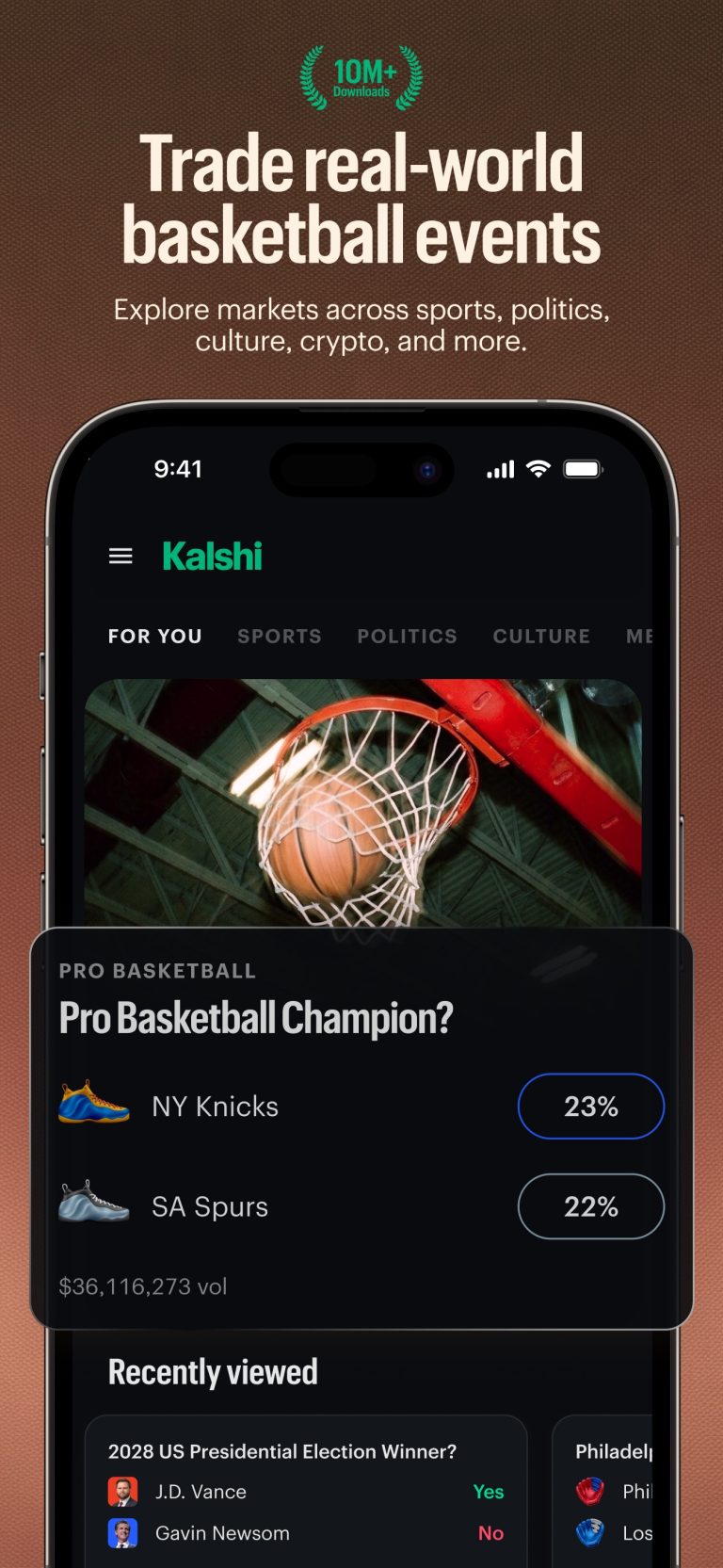
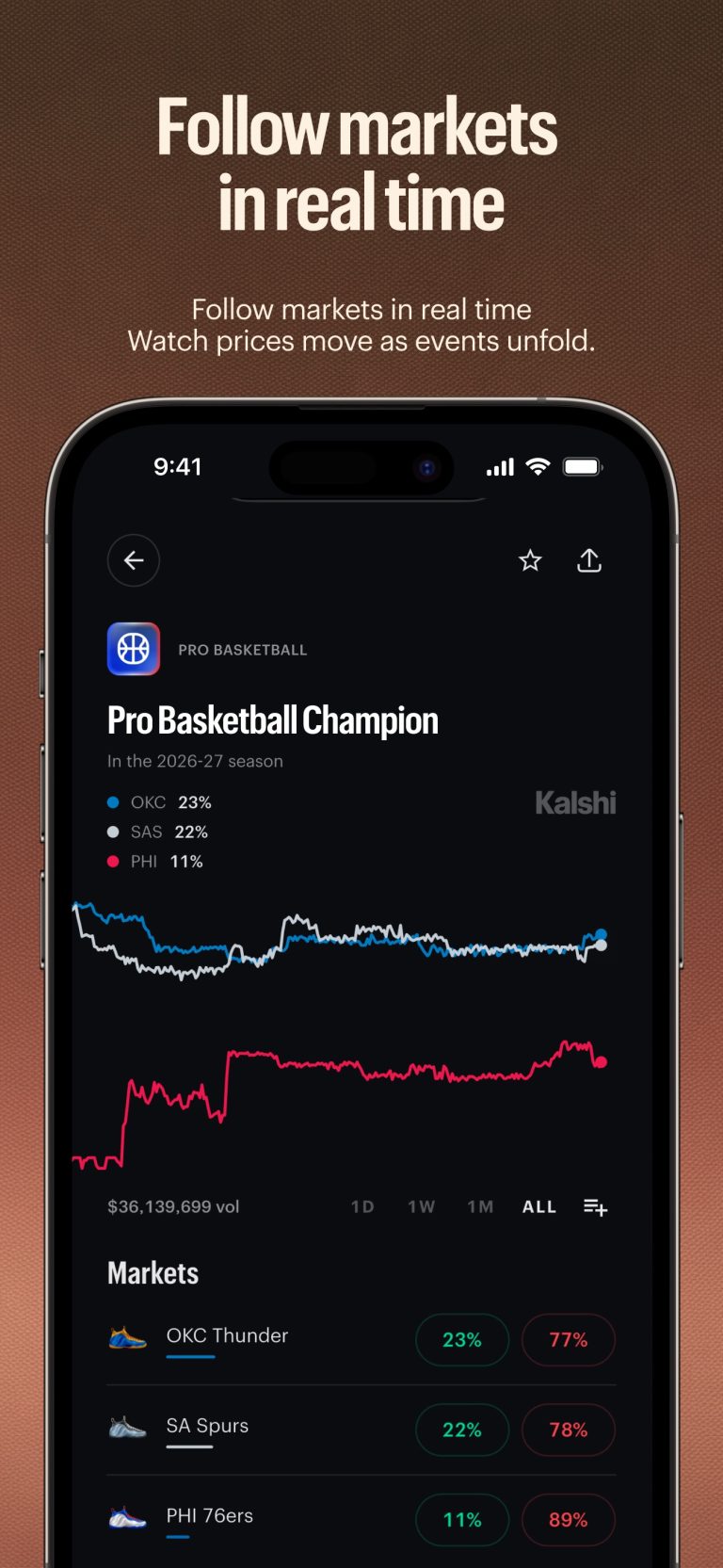
Those numbers rest on a far larger sample than any rival app. By our weighted calculation, which blends both stores and discounts small samples, Kalshi scored 4.796, second only to DraftKings Predictions among dedicated apps.
Where Kalshi Is Available, and the Court Fight Over It
Kalshi accepts customers aged 18 and over. Its position is that federal oversight allows it to serve traders across the country. A growing number of states disagree, and courts have started to carve out exceptions.
- Nevada. A Carson City judge granted the state Gaming Control Board a temporary restraining order in March 2026 blocking Kalshi’s sports, election and entertainment contracts for Nevada residents. On August 28, the Ninth Circuit affirmed the dissolution of Kalshi’s federal injunction, holding that Nevada can treat sports contracts as unlicensed sports betting. Election contracts were sent back to the lower court.
- Washington. A King County Superior Court judge ordered Kalshi to block Washington users from sports, politics, entertainment, culture, tech and science markets, with full compliance due by September 2 or fines of $120,000 a day. Commodities, climate, economics and finance markets remain open.
- Michigan. An Ingham County court order reported on June 30 bars Kalshi from offering or advertising sports contracts in the state, in a suit brought by Attorney General Dana Nessel.
- Ohio and Tennessee. The Sixth Circuit ruled against Kalshi on September 25, finding that the contracts are not swaps and that federal law does not override state gambling statutes. Ohio’s Casino Control Commission had earlier moved to fine Kalshi $5 million.
- New Jersey. The Third Circuit sided with Kalshi on April 6 in a split decision. New Jersey has asked the Supreme Court to hear the case (No. 26-299), and Kalshi’s response is due November 9.
- Maryland. The Fourth Circuit heard argument on May 7; a decision is pending. Separately, the City of Baltimore sued Kalshi and Polymarket under its consumer protection ordinance on August 13.
- Missouri. Attorney General Catherine Hanaway sent cease-and-desist letters to Kalshi and five other platforms on September 18, giving them 30 days to comply.
The appeals courts are now split, which is the usual route to the Supreme Court. Until that is settled, the map of what Kalshi can offer, and where, may keep shifting.
Moving Money In and Out of Kalshi
Withdrawals to a debit card are “normally instant,” Kalshi says, although a payment processor’s security check can occasionally slow one down. The help center does not give standard timings for other withdrawal routes.
| Method | Deposit | Withdraw | Note |
|---|---|---|---|
| Debit card (incl. Apple Pay, Google Pay) | Yes | Yes | Card withdrawals normally instant |
| ACH bank transfer | Yes | Yes | |
| PayPal | Yes | Yes | U.S. only; not in all states |
| Venmo | Yes | Yes | U.S. only; not in all states |
| Cash App | Yes | No | Deposits only |
| Crypto | Yes | Yes | Handled through Zero Hash |
| Wire | Yes ($1,000 minimum) | Yes |
Kalshi issues tax forms covering interest (1099-INT), rewards (1099-MISC), trading results (1099-B) and crypto transactions (1099-DA).
Kalshi Support Channels and Official Site
| Contact | Details |
|---|---|
| In-app chat | Menu, then Get help, then Chat with support |
| support@kalshi.com | |
| Phone | Not offered |
| Help center | help.kalshi.com |
| Official site | kalshi.com |
| Regulatory disclosures | kalshi.com/regulatory |
Kalshi Against Polymarket US and Robinhood
| Kalshi | Polymarket US | Robinhood | |
|---|---|---|---|
| Federal status | DCM with affiliated clearing house and FCM | DCM and DCO | FCM routing to partner exchanges |
| Fee model | Taker fee, $0.07 to $1.75 per 100 contracts | 0.0695 × contracts × p × (1 − p); maker rebates | 5% or 10% × p × (1 − p) per contract, capped at 1¢, plus exchange fee up to 1¢ |
| New-user offer | Referral program only | $25 credit on first $10+ deposit | None found on official pages |
| Minimum age | 18 | 18 | 18 |
| Nevada | Sports, election and entertainment blocked | Trading unavailable | No sports contracts |
| iOS rating | 4.82 (644,723) | 4.55 (63,620) | 4.30 (multi-product app) |
Kalshi and Polymarket US price their fees on almost identical curves, so the choice between them comes down to liquidity, market selection and legal exposure rather than cost. Polymarket US offers a defined sign-up credit; Kalshi does not.
Robinhood adds its own commission, capped at 1¢ a contract, on top of an exchange fee of up to 1¢. It also routes some orders to Kalshi itself, so the two are partners as much as rivals.
Strengths and Weaknesses
Kalshi’s strongest argument is depth. No other venue in Pew’s data comes close to its volume, and deeper order books generally mean tighter prices and fuller fills. Its fee schedule is public and granular, its debit withdrawals are fast, and its range of payment options is among the widest in the sector. The App Store rating, drawn from well over half a million users, is hard to fault.
The weaknesses are the absence of a published welcome offer, the lack of phone support and, above all, legal risk. Kalshi is the named party in nearly every major court case on event contracts. Traders in Nevada, Washington and Michigan have already lost access to whole categories, and the appeals courts that ruled most recently went against it. Volume figures, finally, are notional and should be read as such.
Our Verdict on Kalshi
Kalshi is the benchmark for U.S. event contracts: the longest-licensed, the most liquid and the broadest in scope. For traders who value market choice and transparent pricing over sign-up incentives, it sets the standard. The caveat is that its availability, particularly for sports, now depends on which state you are in and how the courts rule next.
Kalshi Questions From Readers
Is Kalshi legal in my state?
Kalshi is a CFTC-designated exchange and accepts traders aged 18 and over. Court orders currently restrict its sports markets in Michigan; sports, election and entertainment markets in Nevada; and most non-financial markets in Washington. Litigation is ongoing in several other states.
Does Kalshi have a promo code?
Not a public one. Kalshi runs a referral program, and a friend’s referral code can be added within 72 hours of opening an account. The reward depends on that referral offer’s terms.
What is the minimum deposit on Kalshi?
$10 for most methods and $1,000 for a wire.
How much does Kalshi charge per trade?
On most markets, a taker fee of $0.07 to $1.75 per 100 contracts, highest at 50¢. Combos and some series carry maker fees, and a few series are fee-free.
How fast are Kalshi withdrawals?
Debit card withdrawals are normally instant, though a processor security check can occasionally delay them.
How are winning Kalshi contracts paid?
Each winning contract settles at $1, and most markets settle within about three hours of the outcome being known. Losing contracts expire worthless.
How is Kalshi different from a sportsbook?
Sportsbooks are licensed state by state and set their own odds. Kalshi is a federally regulated exchange where members trade with each other and the company earns fees rather than profiting from losses. Several states argue its sports contracts are unlicensed betting regardless.